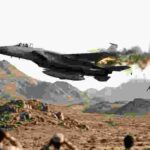
Washington, May 2026 — The U.S. military has raised the stakes in the Middle East, showcasing the B-1B Lancer bomber equipped with its latest hypersonic missile system.
The move, appearing as a direct warning to Tehran, comes at a time when the Biden-Trump transition era military strategy is pivoting toward “high-end” deterrence. While the Pentagon flaunts its “uninterp-table” firepower, a burgeoning domestic crisis is brewing over the staggering, and allegedly hidden, costs of the ongoing conflict with Iran.
The B-1B Lancer: From Cold War Relic to Hypersonic Hunter
For the first time, the U.S. Air Force has released imagery of the B-1B Lancer carrying the AGM-183 Air-Launched Rapid Response Weapon (ARRW). This marks a massive shift for the “Bone,” a bomber once slated for retirement that has now been granted a ten-year lease on life as a hypersonic testbed.
By utilizing external pylons—originally designed for nuclear payloads—the B-1B can now carry 5,000lb-class hypersonic stores. With flight paths that are essentially impossible for modern air defenses to track or intercept, the ARRW is intended to be the “first-look” strike option that ends a conflict before the enemy knows it has begun.
Operation Epic Fury: The $25 Billion Discrepancy
While the Air Force showcases its tech, the Pentagon is facing an “accounting war” on Capitol Hill. Official figures place the cost of Operation Epic Fury at roughly $25 billion, but lawmakers and analysts are calling foul.
The $25 billion figure, officials admit, covers mostly “expended munitions.” What it excludes is the catastrophic cost of regional damage:
- Base Reconstruction: Iranian strikes reportedly hit nine U.S. bases in a single 48-hour window.
- High-Value Assets: Reports indicate the destruction of two C-130 transport planes, a THAAD missile battery in Jordan, and an E-3 Sentry early-warning aircraft.
- The Real Bill: Insiders suggest the actual cost, including base repairs and equipment replacement, is likely closer to $50 billion.
The $200 Billion Request and Future Fallout
The financial gap has led to a massive $200 billion supplemental funding request for the 2027 fiscal year. Defense Secretary Pete Hegseth has notably declined to confirm if the $25 billion estimate includes the rebuilding of overseas installations, leaving a “shadow budget” that critics say is being used to mask the true intensity of the war.
As the U.S. doubles production rates for the ARRW and the Hypersonic Attack Cruise Missile (HACM), the military-industrial complex is thriving, even as the operational footprint in the Gulf remains under constant fire.
Bottom Line
The display of the B-1B’s hypersonic teeth is a masterclass in military posturing, but it cannot mask the financial bleeding. The U.S. is currently fighting two wars: one on the front lines against Iranian-backed forces, and another in Washington to justify a conflict whose price tag is doubling faster than the missiles it uses.