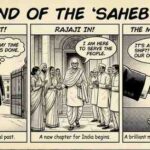
New Delhi, February 2026 — In a move laden with historical and symbolic weight, the Government of India has replaced the statue of British architect Edwin Lutyens at the Rashtrapati Bhavan with that of C. Rajagopalachari.
While the change involves physical monuments, the broader significance lies in the aggressive policy of “Decolonizing the Indian Mind.” By removing the architect of colonial Delhi and honoring the first Indian Governor-General, the state is signaling a final departure from the “Saheb” culture that has dominated Indian power circles for eight decades.
Lutyens: Architecture as a Statement of Superiority
Edwin Lutyens was the mastermind behind the layout of New Delhi, including the Rashtrapati Bhavan (formerly the Viceroy’s House) and the Central Secretariat. However, historical records suggest his vision was far from inclusive.
Lutyens viewed Indian culture as inferior and designed the capital to reflect British imperial might. His architecture utilized massive scales, wide roads, and elevated structures specifically to make the common Indian feel small and governed. Critics argue this “Lutyens Ecosystem” birthed a persistent elitist mentality among bureaucrats and politicians—a “Saheb” culture where the ruler remains detached from the ruled.
Rajaji: The Prophet of Economic Liberty
C. Rajagopalachari, popularly known as ‘Rajaji,’ represents a starkly different vision for India. As a polymath freedom fighter and the last Governor-General, Rajaji was decades ahead of his time.
He was a vocal critic of the “License-Permit Raj,” warning as early as the 1950s that excessive state control would lead to a new form of slavery. He advocated for:
- Free Markets: Rajaji believed in a liberal economy long before the 1991 reforms.
- Limited Government: He famously stated that the government should stay out of citizens’ “kitchens, bedrooms, and libraries”.
- Individual Power: His vision placed the market and the individual above the absolute command of the state.
A Rare Political Consensus
The replacement has found unexpected support even from traditional critics of the current administration. Congress MP Shashi Tharoor, often associated with the Lutyens intellectual circle, praised the move, acknowledging Rajaji’s profound vision for modern India. This rare consensus highlights a collective national desire to reclaim Indian identity from colonial-era legacies.
The Road to Mental Independence
While the physical removal of colonial statues is a milestone, the transition suggests that the real battle is ideological. The government’s “Panch Pran” (five pledges) strategy aims to dismantle the remaining colonial pillars, such as the language of law and the Macaulay-driven education system.
The shift from Lutyens to Rajaji is a reminder that while political freedom was won in 1947, mental and economic sovereignty is a continuous pursuit.
Bottom Line
The departure of Lutyens and the arrival of Rajaji at India’s highest constitutional office marks the beginning of an era of self-confident governance. It is a transition from a mindset of being “governed” by colonial ghosts to being “led” by indigenous wisdom. As Rajaji’s ideas on individual liberty and free markets become central to the national discourse, India moves closer to an “Atmanirbhar” identity that is truly its own.