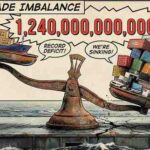
Washington D.C., February 2026 — Despite President Donald Trump’s aggressive “America First” trade strategy, new economic data reveals that the U.S. goods trade deficit surged to a historic high of $1.24 trillion in 2025.
The figures suggest that the administration’s primary economic weapon—imposing heavy tariffs on global partners, including a 50% levy on Indian goods—has failed to shrink the trade gap. Instead, the policy appears to have reshuffled global supply chains without reducing America’s reliance on foreign products.
The “Trade Diversion” Trap
Economists point to a phenomenon known as “Trade Diversion” as the primary reason for the widening deficit. While the U.S. successfully reduced its specific trade gap with China by 32%, the demand for manufactured goods did not disappear; it simply shifted to other nations.
U.S. importers, facing prohibitive tariffs on Chinese and Indian products, redirected their orders to alternative suppliers. This resulted in:
- Taiwan: The trade deficit almost doubled as orders for high-tech components and chips shifted away from China.
- Vietnam: The deficit with the U.S. increased by a staggering 44%.
- Mexico: Imports hit record highs as companies moved production just across the border to bypass overseas tariffs.
The Illusion of Manufacturing Resurgence
A core pillar of the Trump trade policy was the belief that high tariffs would force manufacturing to return to U.S. soil. However, analysts describe this as a fundamental misunderstanding of the U.S. labor market. With a lack of cheap labor and a different economic structure, producing low-cost consumer goods domestically remains unfeasible.
Consequently, the overall trade deficit (combining goods and services) remained nearly stagnant at $901 billion in 2025. The marginal improvement from 2024 was not due to fewer imports, but rather a 6% growth in U.S. service exports like banking and digital services.
Panic Buying and Consumer Costs
The record-breaking numbers in 2025 were also fueled by a “panic buying” phase. Before the full implementation of tariffs, U.S. firms engaged in massive front-loading of imports to secure stock at lower prices.
Crucially, the policy did not force foreign producers to pay the cost. Instead, the tariffs were largely passed on to U.S. consumers, who faced higher prices for everything from electronics to basic household goods.
The Structural Reality
The 2025 data serves as a stark reminder that trade balances are influenced by complex macroeconomic factors—such as domestic investment demand and currency values—rather than simple protectionist policies. While tariffs changed who America buys from, they did not change how much America buys.
Bottom Line
The era of aggressive tariffs has reshaped global trade routes, but it has not balanced the scales. The 2025 record deficit proves that “America First” tariffs acted more as a tax on domestic consumers than a shield for domestic industry. While the administration claims a win in reducing the China gap, the broader $1.24 trillion reality suggests a strategy that moved the problem rather than solving it.