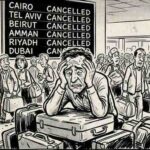
Dubai, March 2026 — One of the world’s busiest aviation arteries has been severed as the conflict between Iran, Israel, and the United States spills into the skies of the United Arab Emirates. Following a series of retaliatory strikes, Dubai International Airport (DXB) and Al Maktoum International have effectively halted operations, stranding hundreds of thousands of travelers—including high-profile Indian athletes and students.
Aviation Hub Under Fire
The disruption began after a drone was intercepted over Dubai, with falling debris causing a fire on the facade of the iconic Burj Al Arab Hotel. While a concourse at DXB sustained only minor damage, the safety risk posed by missiles cutting across West Asian air corridors forced a total shutdown.
The scale of the crisis is immense. DXB typically processes over 260,000 passengers daily; a single day of closure is estimated to wipe out between $10 million and $18 million in terminal revenue alone, with total aviation losses potentially reaching hundreds of millions.
PV Sindhu and 1,200 Indians Stranded
The shutdown has hit Indian travelers particularly hard. Among those caught in the chaos is Olympic medalist PV Sindhu, who was en route to the All England Open in Birmingham. Sindhu shared harrowing updates on social media, reporting that she could hear explosions from her hotel window before being moved to a safer location by UAE authorities.
The crisis extends beyond the airport. Approximately 1,200 Indian students are currently stranded within Iran, living in fear as airstrikes continue. While the Indian Embassy has issued advisories and helped some depart, many remain waiting for emergency evacuation as regional airspace remains closed.
A Region Without Airspace
The conflict has effectively “blinded” westbound international travel from India. Airspace over Iran, Israel, Qatar, Kuwait, Bahrain, Iraq, and the UAE has been temporarily shut, forcing airlines to abandon standard flight paths. Delhi’s Indira Gandhi International Airport has already issued warnings for all westbound flights, advising passengers to prepare for significant delays or cancellations as carriers reassess their routes.
The Economic Ripple Effect
Beyond the immediate fear, the financial impact is staggering. When an airport of DXB’s magnitude stops, airport charges, duty-free sales, and concession revenues vanish instantly. For international airlines, the necessity of rerouting flights adds massive fuel costs and logistical nightmares, a burden that will eventually ripple down to global ticket prices.
Bottom Line
What began as a targeted military exchange has rapidly evolved into a global logistics emergency. With the world’s busiest international hub paralyzed and thousands—including one of India’s biggest sporting icons—waiting for a clear sky, the focus shifts to whether diplomatic channels can re-establish safe corridors before the region’s aviation sector faces a permanent setback.