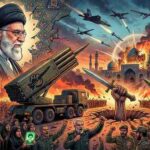
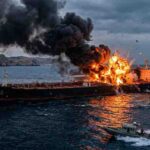
New Delhi, March 2026 — The global energy market is bracing for a catastrophic shock as Iran’s Revolutionary Guard (IRGC) announced a total blockade of the Strait of Hormuz. Following the high-profile assassination of Supreme Leader Ayatollah Ali Khamenei by U.S. and Israeli forces, Tehran has weaponized the world’s most critical maritime choke point in a move that threatens to derail India’s economic stability.
A Choke Point Under Siege
The Strait of Hormuz serves as the jugular vein of the global oil trade, facilitating the movement of 20 million barrels of crude and refined products daily. This accounts for nearly one-fifth of total global consumption.
In a chilling escalation, ships in the region reported receiving VHF radio transmissions from the IRGC explicitly stating that “no ship is allowed to pass”. While Iran has threatened such actions in the past, the current decapitation of its leadership has pushed the regime toward a “nothing-to-lose” strategy that bypasses previous economic restraints.
India’s 50% Vulnerability
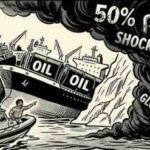
The impact on India is disproportionately severe compared to Western economies. Approximately 50% of India’s crude imports—roughly 2.6 million barrels per day—must pass through the Strait. A prolonged blockade poses an existential threat to India’s fiscal health:
- Import Bill & Inflation: Every $10 increase in crude prices adds billions to India’s import costs, directly fueling domestic inflation and widening the current account deficit.
- Sectoral Meltdown: Industries ranging from aviation and logistics to paints and automobiles are expected to see their margins evaporate as fuel and raw material costs skyrocket.
- The Remittance Risk: Beyond oil, India receives $40–$50 billion annually from the 9 million Indians working in the Gulf—a lifeline that could be severed if regional instability worsens.
Market Panic and Strategic Reserves
Global energy traders have already begun baking the “war premium” into prices. Brent crude is trending toward $80 per barrel, with analysts warning of triple-digit figures if the blockade is enforced for more than a few days.
In response, major energy consumers are looking toward their Strategic Petroleum Reserves (SPR). Member nations of the International Energy Agency (IEA) are mandated to hold 90 days of net imports in reserve, specifically for moments of geopolitical crisis like this.
The “Risk-Off” Ripple Effect
The crisis is not limited to oil. The Indian markets are anticipating a “risk-off” environment where the Rupee weakens and gold prices surge. Historically, India’s Volatility Index (VIX) has jumped between 20% and 40% during such Middle Eastern escalations.
Bottom Line
The era of cheap, reliable energy has been replaced by a geopolitical hostage situation. For India, the blockade is not just a foreign policy challenge; it is a direct threat to the wallet of every citizen. With 50% of its oil at stake, the government now faces its most significant energy security test in decades.